Global Medicine
UC San Diego offers a number of unique global health opportunities, both locally, given UC San Diego's proximity to the US-Mexico border (which is just a 20 minute drive from the UC San Diego Hillcrest Hospital!) and globally. Med-Peds residents are able to attend a variety of activities, from teleconferences to local global health opportunities in San Diego or Tijuana, to completing rotations in different countries around the world!
International Educational Conferences and Events
International Morning Teleconferences
As part of the Med-Peds program at UC San Diego, residents are able to participate in and attend international teleconferences while rotating on both internal medicine and pediatrics. While on internal medicine, Med-Peds residents attend teleconferences in collaboration with the internal medicine residency program at Universidade Eduardo Mondlane in Maputo, Mozambique. Residents from UC San Diego and those from Mozambique take turns each month presenting a case from their respective institution. Med-Peds residents also have the opportunity to travel to Mozambique for 1–2 months; see below for more details.
While rotating through pediatrics, Med-Peds residents attend monthly teleconferences done in collaboration with the Hospital Civil de Guadalajara in Guadalajara, Mexico. Residents from Guadalajara present a case seen there in Spanish; fluency in Spanish is not required to attend, as medical translators are present to translate the case to UC San Diego residents and faculty. These presentations also alternate between those given by UC San Diego residents.
Cultural Immersion Days
These are a series of afternoon sessions held on Pediatrics, designed to increase resident understanding of the many cultures present in the San Diego area and how these and other societal factors can contribute to child health. Examples of cultural immersion days include Traditional Mexican Healing, Military Families, and LGBTQ communities.
International Experiences
Local Opportunities
Through pediatrics, Med-Peds residents are able to complete the Think Locally, Act Globally elective. This unique elective allows residents to work in a variety of settings in San Diego as well as in Tijuana, Mexico, and provides exposure to the diverse cross-border immigrant and refugee populations in this area.
UC San Diego International Health Collective (IHC): Free Clinic in Tijuana, Mexico
Residents in the Med-Peds program have the opportunity to volunteer at the UC San Diego IHC free clinic in Tijuana, Mexico. The clinic is held on one Saturday each month from 8 a.m. – 4 p.m., and approximately 100 pediatric and adult patients are seen during the course of the day. Residents staff patients with UC San Diego faculty who are present at the clinic. The clinic is student-run and provides free medical care and health education to families without access to healthcare.
Resident Exchange with Maputo, Mozambique
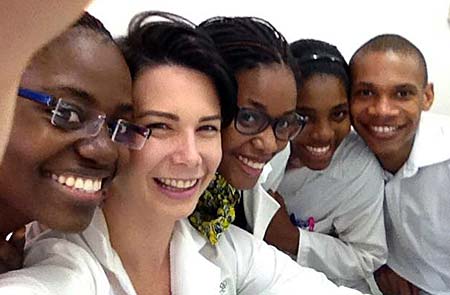
Med-Peds residents have the opportunity to participate in a 1–2 month elective in Maputo, Mozambique as part of a bidirectional exchange program with the UC San Diego Internal Medicine Residency Program. The rotation takes place in Mozambique's capital, Maputo, at the main hospital in the city. If taken as a two-month elective, the resident is expected to complete a research project in Maputo. Since the inception of the exchange program, over 110 UC San Diego residents have gone to Mozambique, and over 20 residents from Mozambique have traveled to San Diego! Though the rotation is set up through the medicine program, Med-Peds residents may be able to see both adult and pediatric patients while in Maputo.
Other International Opportunities
Med-Peds residents have set up electives in locations such as Zimbabwe, Kenya, Egypt, Saipan, Chile, and more. Med-Peds residents are able to pursue a total of 2 months of away electives or research during their 4 years of residency.